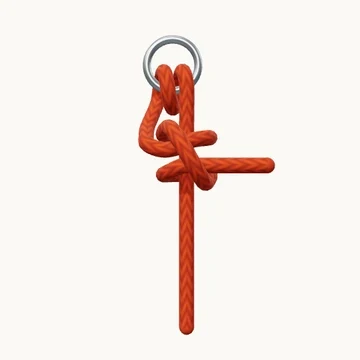
Wrap a support, then secure the tail with two half hitches.
The round turn puts more rope in contact with a support before the tail is secured. After encircling the post or ring, tie two half hitches around the standing part. Those finishing hitches should turn in the same direction.
The initial wrap and the finish serve different purposes. The wrap bears against the support; the half hitches keep the tail from running back. Compare ordinary two half hitches to see how the starting pass changes while the finishing structure remains similar.
When to use it
Attach a line to a post, ring, or rail.
Keep in mind
Tie both half hitches in the same direction.
Check your knot
The round turn is complete before the finishing hitches.
Both half hitches surround the standing part.
The second hitch follows the first in the same direction.
How to tie Round Turn & Two Half Hitches
Start below the ring
Bring the working end toward the metal ring.
Approach the opening
Keep the standing part below the ring as the end rises in front.
Pass through the ring
Take the end up through the opening and down behind the lower bar.
Complete the round turn
Continue below the bar and through the ring again in the same direction.
Wrap the standing part
Bring the end down on the left, across the front, and around the standing part.
Cross over the front
Bring the end diagonally across the first turn to begin the next hitch.
Make the second turn
Go around the standing part in the same direction as before.
Tuck under the diagonal
Pass the end beneath the diagonal crossing and bring it out to the right.
Leave the working end
Leave a short tail after the two hitches.
Check the attachment
Two passes hold the ring. Two same-direction half hitches secure the tail around the standing part.