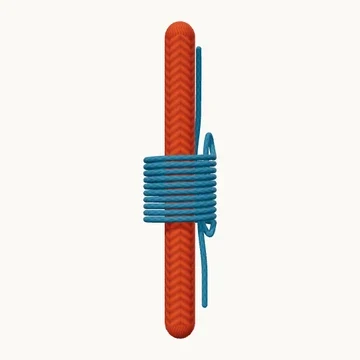
Bind a rope end with twine and bury the joining loop beneath the turns.
Common whipping holds a rope’s outer strands together with a close band of twine. A long fold is laid along the rope, and the working twine wraps over both legs of that fold. The final end goes through the exposed loop before the starting tail draws the join underneath the band.
The model leaves both twine ends long so their movement is visible. In use, arrange the whipping near the rope end and finish the ends only after the buried join holds. Keep each turn beside the previous one rather than stacking them.
When to use it
- Bind a fraying rope end.
- Practice hiding a twine join under a wrapping band.
Keep in mind
Common whipping can slide or unravel if damaged. It binds an end; it does not repair damaged rope or restore its strength.
Check your knot
- The wrapping turns cover both legs of the original fold.
- The end passes through the exposed fold.
- The join finishes under the middle of the band.