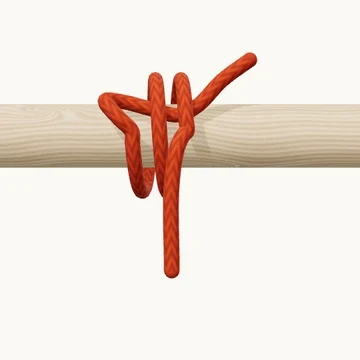
Make two turns around a bundle and tuck the end beneath both.
The strangle knot is a binding made with a double-overhand structure around its support. After two turns, the end crosses back beneath them. Tightening brings the turns together and holds the crossed ends against the bundle.
The support occupies the center of the knot, so the return goes between the wrapping turns and the object. It does not simply cross over the front of both wraps. This is a useful comparison with the constrictor, which locks its end under a distinct riding diagonal.
When to use it
- Bind a small bundle or gathered material.
- Make a temporary binding near a rope end.
Keep in mind
A heavily tightened strangle knot may jam. It is a binding around an object, not a substitute for an end-to-end rope join.
Check your knot
- Two complete turns surround the bundle.
- The end returns under both turns.
- The binding closes evenly when the ends are pulled apart.