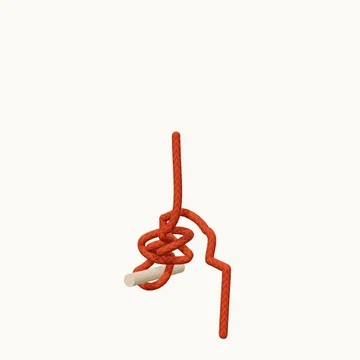
Capture a toggle with a bight drawn from the standing part of a rope.
The marlinspike hitch makes a temporary grip around a bar or toggle. Form an opening, draw a bight of the standing part through it, then place that bight over the toggle. The long loaded side tightens the noose around the bar.
Choosing the folded part is essential. A similar-looking fold taken from the free tail behaves differently when pulled. The animation begins with the loose opening formed, keeps the standing part above the hitch and carries the opened bight beyond the toggle end before sliding it into position.
When to use it
- Add a temporary handle when pulling light cord.
- Study the difference between a standing-part bight and a slipped working end.
Keep in mind
A toggle can slip out when the line is unloaded or pulled from the wrong side. Use an appropriate bar and keep its ends clear of accidental release.
Check your knot
- The bight comes from the standing part.
- The toggle is inside the intended bight.
- Pulling the standing side closes the noose around the toggle.