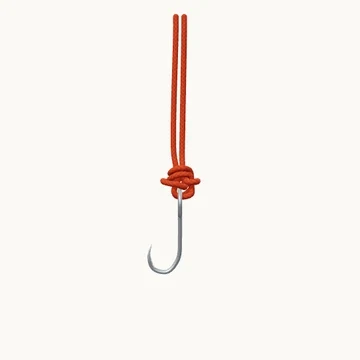
Work with the closed bight. Both free ends remain above the hook.
Fishing · 10 steps
Attach a hook or lure with a doubled line and an overhand knot.
The Palomar begins by taking doubled line through an eye and tying a loose overhand with the folded end. The hook or lure then passes through the remaining loop. Drawing the line down completes the attachment around the eye.
Leave a large enough loop for the whole item to pass through without catching. The doubled line should not twist or cross itself at the eye while the knot is seated. The final pass over the hook is essential; stopping at the overhand leaves the attachment unfinished.
When to use it
Tie line to a hook, lure, or swivel.
Keep in mind
The hook or lure must pass through the final loop; leave enough room.
Check your knot
Both strands pass through the eye together.
The complete hook or lure goes through the folded loop.
The strands sit cleanly at the eye without a trapped twist.
How to tie Palomar Knot
Fold the line
Work with the closed bight. Both free ends remain above the hook.
Pass the closed bight
Push the folded end through the hook eye.
Make a loose overhand
Carry the bight around the doubled standing line to form the overhand loop.
Pass through the overhand
Bring the closed bight through the opening, keeping both legs together.
Open the bight
Make the bight large enough for the whole hook.
Pass below the hook
Extend the closed fold beyond the entire hook.
Bring it around the hook
Move the bight around the far side of the hook.
Return above the eye
Draw the bight up around the overhand portion, above the hook eye.
Draw the turns together
Guide the overhand and its surrounding collar together above the eye.
Inspect the Palomar
The final collar sits above the eye. Moisten real line before pulling both free ends to snug the knot.