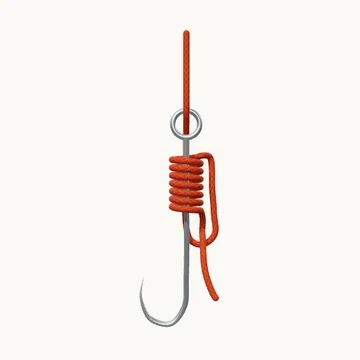
Attach a hook by wrapping its shank and trapping the line beneath a row of turns.
Also known as Easy Snell.
A Snell grips the hook shank rather than placing all of the knot at the eye. The line passes through the eye, lies along the metal, and is secured by a row of turns. In this end-threading version, the tag finishes through the remaining loop below the wraps.
The direction through the eye affects how the standing line leaves the hook. Check it against the hook’s shape and intended rig. Keep each turn around both the shank and the straight line section, rather than wrapping an empty loop beside the metal.
When to use it
- Attach a suitable eyed hook to a leader.
- Learn the difference between a shank attachment and an eye knot.
Keep in mind
Hook shape, eye angle and line stiffness affect seating. Keep fingers away from the point while tightening and check the finished attachment on the actual hook.
Check your knot
- The standing line exits the eye in the intended direction.
- The turns enclose the shank and the straight line section.
- The tag is trapped when the lower loop is drawn out.