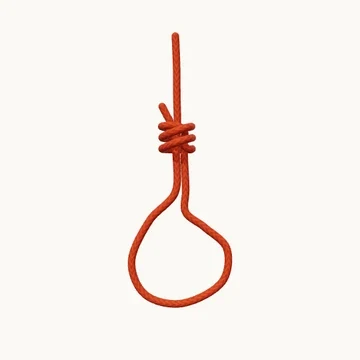
Make a sliding eye with a three-turn overhand barrel around the standing rope.
Also known as Triple-overhand noose.
The scaffold knot adds a third turn to the barrel used by a poacher’s knot. The standing rope runs through that barrel, allowing the eye to close around an object as the line is pulled. The return end must travel through the center of all three turns.
The name can be confusing: this is a sliding noose, not a fixed eye like a bowline. The model leaves the eye open to make the barrel’s connection to the standing line visible. Arrange the three turns together before seating them.
When to use it
- Make a sliding attachment for a suitable object.
- Compare two-turn and three-turn barrel nooses.
Keep in mind
The eye tightens under load and the barrel can jam. Keep tightening loops away from people and animals; use a fixed-loop knot when the eye must keep its size.
Check your knot
- Three turns form the barrel.
- The return passes through all three.
- The standing part can slide through the body to close the eye.