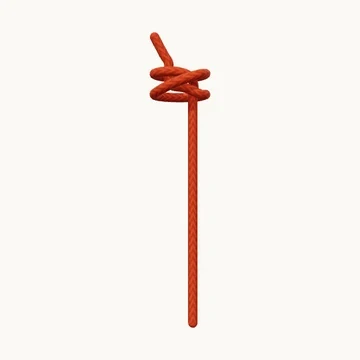
Make a compact stopper with two turns and a return through their center.
Also known as Double overhand knot, Barrel stopper.
The double overhand adds a second turn to a simple overhand stopper. When dressed, those turns form a short barrel around the returning end. It provides a larger obstruction than a single overhand and is a useful building block for several other knots.
The same barrel appears in a double fisherman’s bend, where each end ties around the other rope. Here there is no second rope: the barrel is tied in one line as a stopper. Leave enough working end to keep both turns organized while drawing them together.
When to use it
- Stop a cord end from passing through a small opening.
- Practice the barrel used in a double fisherman’s bend.
Keep in mind
A loaded double overhand can jam. Check the finished stopper against the actual opening; its name does not guarantee that it is large enough.
Check your knot
- There are two turns, not one.
- The returning end passes inside both turns.
- The coils lie next to each other without an extra crossing.