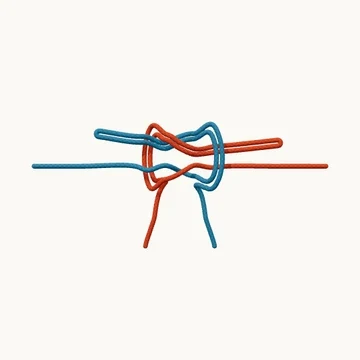
Shoelace Bow

Shoelace Bow
Preparing the rope…

Arrange the lace ends

1/8

Leave two ends long enough for the starting knot and two loops.

Basics · 8 steps

Tie a balanced shoelace bow using the two-loop method.

Also known as Bunny-ears knot, Two-loop shoelace knot, Bowknot.

A shoelace bow is a square knot finished with two folded ends. The folds make the bow loops; the short free ends let you release it. This lesson uses the two-loop, or bunny-ears, method so the movement of each fold stays visible.

Tie the starting half knot, make a loop in each end, then tie the loops in the opposite direction. Repeating the same direction makes a granny bow, which tends to sit lengthwise on the shoe. A balanced bow normally lies across it. The two methods can look similar until you trace the crossings.

When to use it

  • Tie everyday shoelaces.
  • Practice a binding that releases from its free ends.

Keep in mind

Smooth, round or springy laces may still work loose. Check the bow during use and avoid loops long enough to catch underfoot.

Check your knot

  • The second half knot opposes the first.
  • Two complete loops and two free tails remain.
  • The center is snug before you shorten either loop.
How to tie Shoelace Bow
  1. Arrange the lace ends

    Leave two ends long enough for the starting knot and two loops.

  2. Cross the ends

    Bring one end over the other.

  3. Tie the first half knot

    Tuck underneath and draw the first half knot together.

  4. Fold both ends into loops

    Make two closed bights. The free tails remain outside.

  5. Cross the two loops

    Work with the folded loops in the opposite direction to the first half knot.

  6. Pass one loop beneath the other

    Feed the folded loop through the opening, carrying both sides together.

  7. Draw out both bow loops

    Pull the loops apart. The two opposite half knots make a bow that sits across the shoe.

  8. Draw the bow together

    Pull the two loops apart to gather the center. Keep both short release tails outside.

Explore the 3D steps
References & further reading