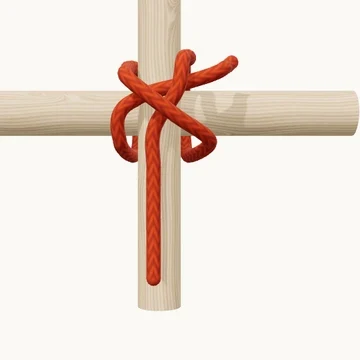
Bind two crossing sticks with a constrictor-style crossing and locked return.
A transom knot holds two small spars across one another. Its route carries the binding around the crossing and locks the end beneath the riding part, using the gripping idea of a constrictor. The wood stays at right angles while the rope draws the joint together.
Follow the turns around the backs of the spars as well as the visible front crossing. A neat X on the front is not enough if a return misses the locking passage. This compact binding is useful to compare with a full square lashing, which builds a larger wrapping band and fraps.
When to use it
- Bind crossing sticks for light craft or camp work.
- Study a compact alternative to a full lashing.
Keep in mind
A small binding is not a substitute for a designed structural joint. Smooth, tapered or flexible sticks can still move under load.
Check your knot
- The turns engage both crossing spars.
- The return passes beneath the intended riding strand.
- The joint closes without a loose turn behind the wood.