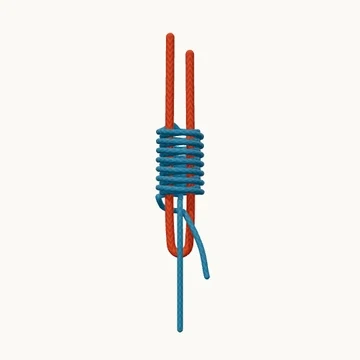
Alberto Knot

Alberto Knot
Preparing the rope…

Fold the leader

1/8

Hold an open fold in the heavier leader and bring the braid toward it.

Fishing · 8 steps

Join braid to a folded leader with an outward row of wraps and a return row.

Also known as Modified Albright.

The Alberto knot builds on the folded-leader arrangement of an Albright. The thin line first winds away from the fold, then reverses along the same section. The return turns cross over the first layer rather than simply extending the band.

The lesson shows seven turns out and seven back. Follow the thin line at the final passage: it must leave the leader fold on the same side as its standing part. Pulling on the wrong exit arrangement can undo the work even when the outside coils look convincing.

When to use it

  • Connect fishing braid to a heavier leader.
  • Compare a return-wrap join with the one-way Albright.

Keep in mind

Turn counts and seating depend on line diameter, stiffness and coating. Test the actual combination before trimming; the animation does not establish a breaking strength.

Check your knot

  • Every wrap encloses both leader legs.
  • The return row runs over the outward row.
  • Both thin ends emerge on the same face of the fold.
How to tie Alberto Knot
  1. Fold the leader

    Hold an open fold in the heavier leader and bring the braid toward it.

  2. Enter the fold

    Pass the thin end through the fold from front to back.

  3. Start the outward wraps

    Wind around both leader legs, moving away from the fold.

  4. Complete seven outward turns

    Keep all seven turns next to one another.

  5. Reverse toward the fold

    Wind back over the first row in the same winding direction.

  6. Complete seven return turns

    Keep the return turns organized over the outward layer.

  7. Exit on the original side

    Pass through the fold from back to front, so both thin ends leave on the same face.

  8. Seat the return wraps

    Draw the outward and return layers together around the leader. Both braid ends stay on the original face of the fold.

Explore the 3D steps
References & further reading