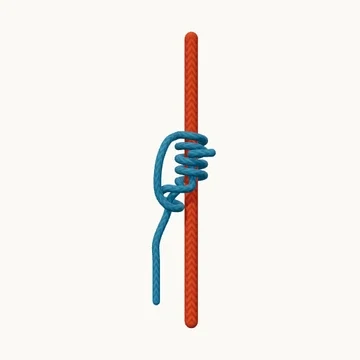
Form a four-turn friction hitch with a return tucked beneath the lower two coils.
Blake’s hitch uses a working end rather than a closed sling. The common four-two arrangement has four turns around the host rope, followed by a return that goes around its own standing part and rises beneath the bottom two turns. The tag exits between the second and third coils.
That final exit identifies the variant shown here. Returning under all four turns or omitting the pass around the standing part changes the hitch. Keep the turns ordered while working the end back upward.
When to use it
- Study an arborist friction-hitch structure.
- Compare an end-tied hitch with a closed-loop Prusik or Klemheist.
Keep in mind
Rope compatibility and a suitable backup stopper matter in practical systems. Tree climbing requires trained instruction; the animation alone is not a climbing setup.
Check your knot
- Four turns surround the host rope.
- The return goes around the hitch’s own standing part.
- The tag passes under two lower turns and exits between turns two and three.