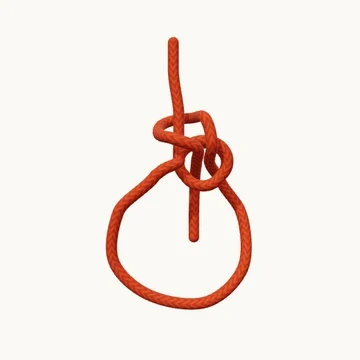
Double Bowline

Double Bowline
Preparing the rope…

Leave rope for the eye

1/9

Keep a long working end below the standing part.

Loops & Ropework · 9 steps

Make a fixed eye with two nipping turns and a collar around the standing part.

A double bowline adds a second small turn to the familiar bowline. The working end passes through both openings, goes around the standing part, and returns through the same pair. The large eye is still a single working loop; “double” refers to the two nipping turns.

Keep the two turns in the same direction and align their openings before threading the end. The collar belongs around the standing rope above them. It does not go around one side of the large eye. This lesson leaves the tail inside that eye.

When to use it

  • Make a fixed loop when a double-turn bowline is appropriate.
  • Compare the collar and nipping turns with a standard bowline.

Keep in mind

An extra turn does not make a bowline immune to loosening. Critical rope systems need the specified finish, sufficient tail and instruction appropriate to the activity.

Check your knot

  • There are two aligned nipping turns.
  • The end passes through both on its way in and out.
  • The collar surrounds the standing part.
How to tie Double Bowline
  1. Leave rope for the eye

    Keep a long working end below the standing part.

  2. Make the first small loop

    Form the first nipping turn beside the standing part.

  3. Add the second loop

    Repeat in the same direction, keeping both openings aligned.

  4. Form the large eye

    Bring the end down, around, and up behind the two small loops.

  5. Pass up through both

    Come through the two nipping turns from behind to the front.

  6. Collar the standing part

    Take the end around the standing part above both small loops.

  7. Return through both turns

    Take the end back through the two openings beside its first passage.

  8. Leave the tail inside

    Bring the tail out inside the large eye.

  9. Dress the double bowline

    Arrange the two nipping turns together. The collar surrounds the standing part and the tail stays inside the eye.

Explore the 3D steps
References & further reading