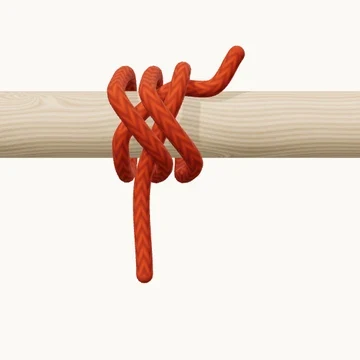
Bind a bundle with two riding turns and a tail tucked beneath both.
A double constrictor adds another riding turn to the constrictor’s binding structure. The diagonal turns cross the front of the bundle and trap the working end underneath. Both riding turns must be in place before the final tuck.
Keep the parallel diagonals organized as you tighten. An extra wrap around the back alone is not the same as the shown second riding turn. Rotating the model reveals how the end travels beneath the crossing strands while the rear turns encircle the support.
When to use it
- Bind a bundle tightly.
- Compare a double riding turn with a standard constrictor.
Keep in mind
This binding can be difficult to untie and may need to be cut. Protect anything that could be damaged by concentrated pressure.
Check your knot
- Two diagonal riding turns cross the front.
- The tail passes beneath both and the underlying turn.
- The wraps lie together on the bundle.