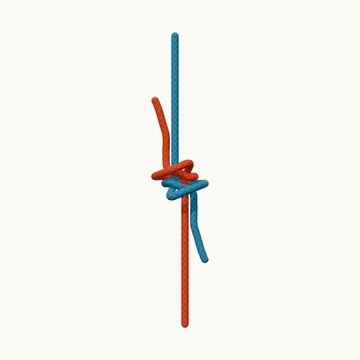
Join two ends with opposing single overhand knots tied around the other rope.
Also known as Fisherman’s bend, English knot.
The fisherman’s knot is a pair of overhand knots: each end ties around the opposite standing line. Pulling the standing parts brings the two small knots against one another. Keeping the pair open while learning makes it easier to see which line each end surrounds.
This is the single fisherman’s version, with one turn in each half. The double fisherman’s uses two-turn barrels instead. Despite the name, the single version is not a universal choice for modern fishing lines, particularly very smooth materials.
When to use it
- Join similar small cords for light general use.
- Learn how opposing stopper knots form a bend.
Keep in mind
The single version may slip in slick line and can jam after loading. Match the bend to the material and purpose rather than relying on its fishing name.
Check your knot
- Each overhand encloses the other rope.
- The two standing parts pull in opposite directions.
- Both tails remain visible beyond their own knots.