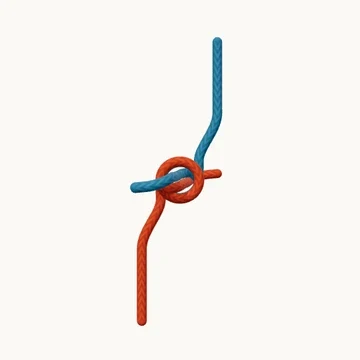
Join two ropes by passing their ends in opposite directions through overlapping loops.
Also known as Rosendahl bend.
The zeppelin bend connects two interlocking overhand structures. Start with oppositely oriented loops, place one over the other, then take each end around and through the shared opening from its own side. Both ends must complete the interlock.
Its paired loops can look convincing before the last passes are correct. Use the central opening as the reference point and check the two ends separately. The completed bend is commonly chosen for an orderly join that can be untied after ordinary loading.
When to use it
- Join two suitable ropes for general ropework.
- Practice an interlocking bend with a symmetrical layout.
Keep in mind
A familiar-looking outline is not enough to identify the bend. Inspect both tail paths; do not apply a general knot description as a load rating.
Check your knot
- The starting loops have opposite handedness.
- Both tails pass through the common opening.
- The two tails travel through that opening in opposite directions.