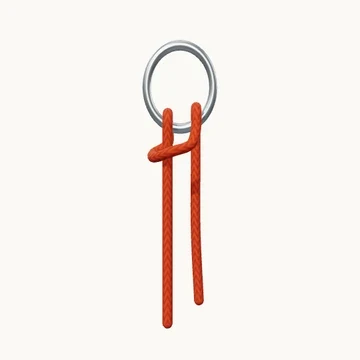
Study the crossing and two connector passes of a Munter hitch in an interactive 3D view.
Also known as Italian hitch, HMS hitch.
The Munter hitch turns a rope around a suitable connector and back across itself. Its crossing can roll as rope travel changes direction. That moving crossing is part of the structure, so the hitch should not be confused with two fixed, opposing turns of a cow hitch.
This lesson uses an end-threading sequence on a closed connector to expose the route. In practice, the hitch is often installed as a bight in an appropriate locking carabiner. Learning its shape is only one part of learning a belay system.
When to use it
- Understand the rope path of an Italian hitch.
- Compare a rolling crossing with a fixed attachment hitch.
Keep in mind
Belaying requires practical instruction, suitable locking equipment and continuous brake control. This model does not teach a complete belay procedure.
Check your knot
- The rope passes through the connector twice.
- The connecting section crosses around the standing side.
- The two running parts emerge on the intended faces of the connector.