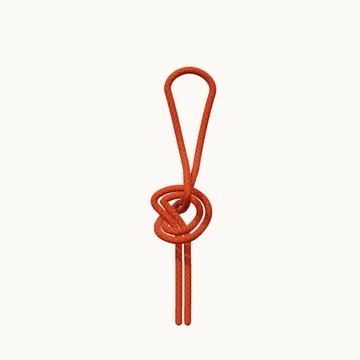
Form a fixed loop by tying an overhand knot in a doubled section of rope.
Also known as Overhand on a bight, Loop knot.
The overhand loop is one of the shortest routes from a folded rope to a fixed eye. Hold the doubled section as if it were one strand, make an overhand, then pass the closed fold through the opening. Both legs of the loop follow the same path through the knot.
Its simplicity is useful when a small fixed loop is more important than easy untying. A figure eight on a bight adds another turn and is easier to identify at a glance. Both methods require a folded end, so a finished loop cannot be threaded through a closed ring without another tying method.
When to use it
- Add a fixed loop to ordinary cord.
- Practice passing a closed bight through a knot.
Keep in mind
An overhand loop can become difficult to untie after tension. It is not an adjustable loop.
Check your knot
- Both strands follow the entire overhand together.
- The loop has no twist between its legs.
- The tail is long enough to remain visible after dressing.